Astronomical Unit (AU)
Defined by the distance Earth-Sun (~150 million kilometers), the astronomical unit serves as a unit of measurement in planetary systems.

Defined by the distance Earth-Sun (~150 million kilometers), the astronomical unit serves as a unit of measurement in planetary systems.
Consists in breaking heavy atoms (such as uranium) into several smaller ones, which is accompanied by a significant release of energy.
Consists of the fusion of light atoms (such as hydrogen) to form heavier ones, which is accompanied by a significant release of energy.
Noted 2H or D - isotope of hydrogen whose nucleus is composed of a proton and a neutron.
Object of the solar system in hydrostatic equilibrium (spherical shape or almost) not being a satellite but not having cleaned the neighborhood of its orbit.
Elementary particle, component of atoms and carrying a negative electric charge. It is responsible for the interactions between atoms.
An attractive force that is part of the four fundamental interactions that govern the Universe. Gravitation is responsible for the tides with the Moon, holds the planets of the solar system in rotation around the sun, and causes objects to fall to the Earth.
Noted H - lightest atom in the universe whose nucleus is composed of a single proton.
State in which stars are when gravitation and radiative pressure are balanced, stabilizing the star in a spherical shape.
In planetology, ice is used to describe volatile substances such as water, methane, nitrogen, ammonia, etc.
Atoms sharing the same number of proton-s, but having a different number of neutrons.
Example with hydrogen:
Energy that a body possesses as a result of its motion.
More precisely, it is the energy required to bring the object at rest.
When hydrogen is subjected to very high pressure, the hydrogen nuclei (a single proton) eject their single electron, forming a proton lattice. Free, the electrons then behave in the same way as those of a conducting metal.
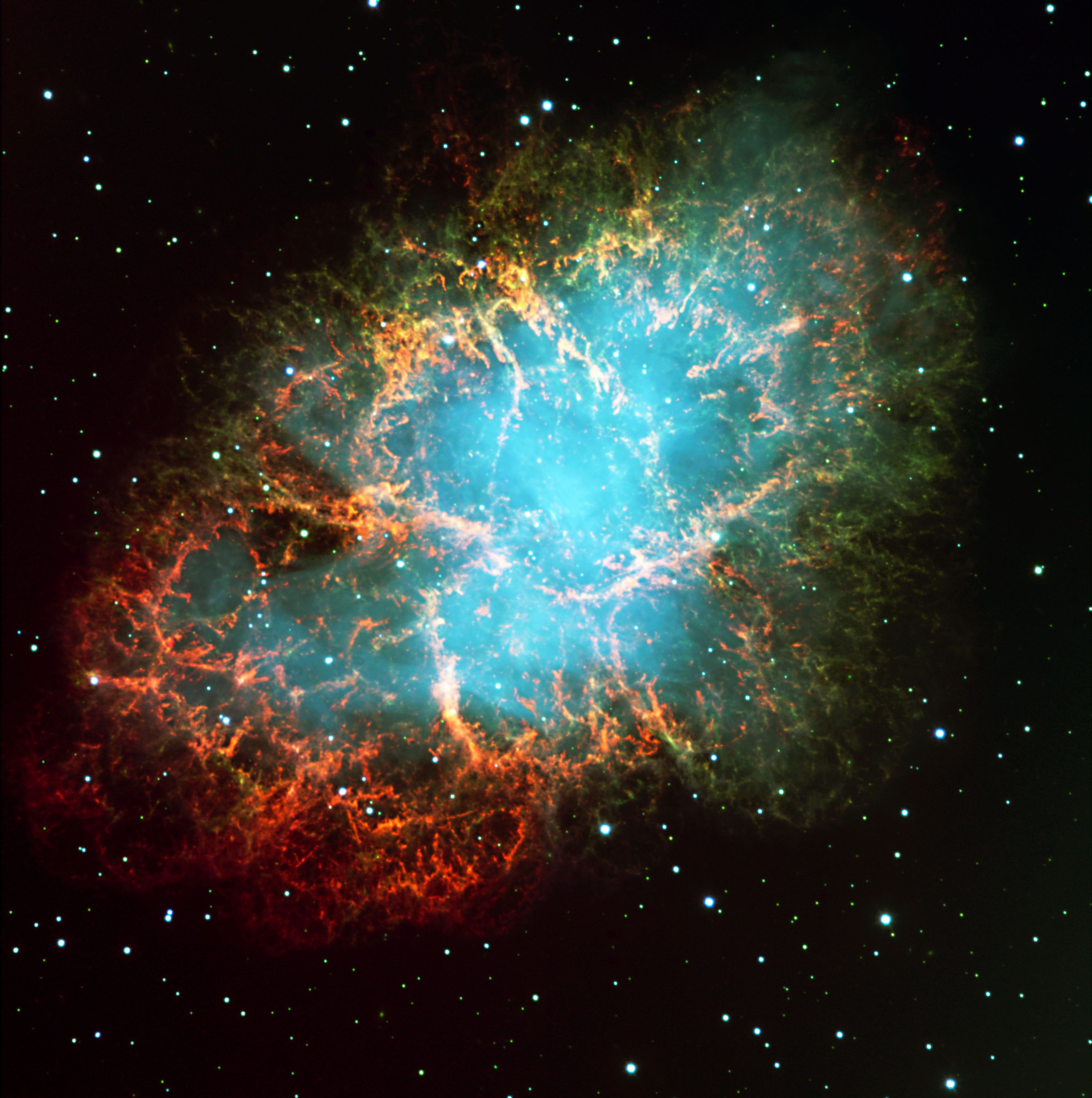
A nebula designates, in astronomy, a cloud composed of rarefied gas, plasma or interstellar dust.
Subatomic particle, part of the atomic core. It carries a neutral electric charge.
High density remnant (between 1.4 and 3.2 solar masses in a ball of only 20 to 40 kilometers in diameter) of a high mass star, composed entirely of a neutron soup. Neutron stars have an intense magnetic field and a very high rotation speed.
A neutrally charged particle with almost no mass, representing a packet of electromagnetic energy exchanged when energy is absorbed or emitted by matter.
The photon can be considered both as a particle and a wave. It is responsible for electromagnetic radiation, therefore light, radio waves, gamma rays ...
Its speed in vacuum, called the speed of light, is equal to 299 792 458 m / s.
Fourth state of matter (with the solid state, the liquid state and the gaseous state), in which the electrons are separated from the atomic nucleus.
Subatomic particle, part of the atomic core. It carries a positive electric charge.
An atom is said to be radioactive when it is unstable and can transform into another atom, while emitting particles and energy.
Time taken by a star or planet to circle another star or planet around which it orbits.
Time that a star or a planet takes to make a turn on itself.
A material is superconducting when it has no electrical resistance below a certain temperature. When supplied with electricity, it will produce a very intense magnetic field without any energy loss
Implosion of a relatively high-mass star (over 8 solar masses) at the end of its life, or of a white dwarf that has exceeded the Chandrasekhar limit by siphoning off a neighboring star.
Torus designed to magnetically confine a plasma in order to perform fusion operations.
Noted 3H ou T - hydrogen isotope whose nucleus is made up of one proton and two neutrons.